If organisations evolve in real time, why are their brand systems still static?

The future of brand expression is more organic
In the latest instalment of our In Conversation series, Ben Harding, Managing Director, speaks with Simon Chuck, Associate Creative Director at NewTerritory, the global design and brand experience studio. With teams in London and Atlanta, NewTerritory has extensive experience across hospitality, rail, automotive and aviation.
As consumer expectations evolve and AI reshapes the relationship between brands and audiences, traditional identity systems are beginning to show their limitations. Today’s brands are expected to move with culture in real time, adapting across communities, behaviours, regions and individual contexts while still remaining recognisably themselves.
In this conversation, we explore the idea of the “organic brand” - a flexible, intelligent brand system designed to evolve continuously rather than exist as astatic set of rules. From AI-powered personalisation and adaptive brand frameworks to live design systems and machine-readable guidelines, we discuss how pace of organisational change is fundamentally reshaping how brands need to behave in the world.

Ben Harding (BH): In the last few years, the relationship between brands and consumers has fundamentally changed. What’s shifted, and why does that put pressure on traditional brand systems.
Simon Chuck (SC): Consumers are no longer bystanders of a brand, they are deeply integrated into its evolution.They participate in activations, wear products, shape a brand’s direction and can damage a reputation with a single review.
In the past, the brand was the one who sets the rules and the audience followed. Today, the relationship is far more reactive and symbiotic as both culture, and a growing expectation for personalisation, is shaping brands.
The pace of this change is driving brands to constantly adapt, responding not just globally but at a micro level - influenced by communities, regions, cities, and subgroups. This places pressure on traditional brand systems: they were designed to represent a brand at a fixed point in time, while modern audiences expect responsiveness. Brand systems must be willing to be far more organic to keep pace. Kia Automotive is a prime example of this shifting in perception from a more budget space into a more culturally relevant future mobility brand through bold visual identity shifts and design strategy something the many European automotive manufacturers have struggled to do due to slower moving brand legacy.

BH: So, what do you mean by an “Organic” Brand?
SC: To us, more “organic”brand systems are those designed not as a fixed rulebook, but as a living framework, allowing companies flexibility while still retaining foundational identity and purpose.
Rather than locking a brand into rigid guidelines, we can now build organic brand systems that define the deeper constants: values, behaviours, tone and intent and lets the outward expression adapt. The brand can respond seamlessly and authentically to the zeitgeist, whether that’s a global cultural shift, a regional nuance or a community movement. In this model, real-time responsiveness mirrors the customer’s mental, physical and social environment, allowing the brand to shape-shift into the relevance of the moment without losing who it is.
The rise of AI has made this infinitely more possible. Brands can now meaningfully understand individual customers and their context not just demographics, but behaviours, preferences, moral foundations and situational signals enabling real-time adaptation of messaging, services and experiences. Rather than feeling manufactured, the brand expression becomes situationally appropriate: the brand appears at its most authentic form in that specific moment, for that specific person.
We see an organic brand system as an intelligent scaffold: a stable core that flexes to external stimulus. Instead of resisting change, it anticipates and absorbs it, making the brand feel present, aware and human. This adaptability increases appeal, strengthens loyalty, and keeps organisations relevant as the pace of culture and expectation continues to accelerate, and let’s be honest, even keep track of.
BH: Tell us about some of the recent work you’ve been doing in this space and what you’ve found?
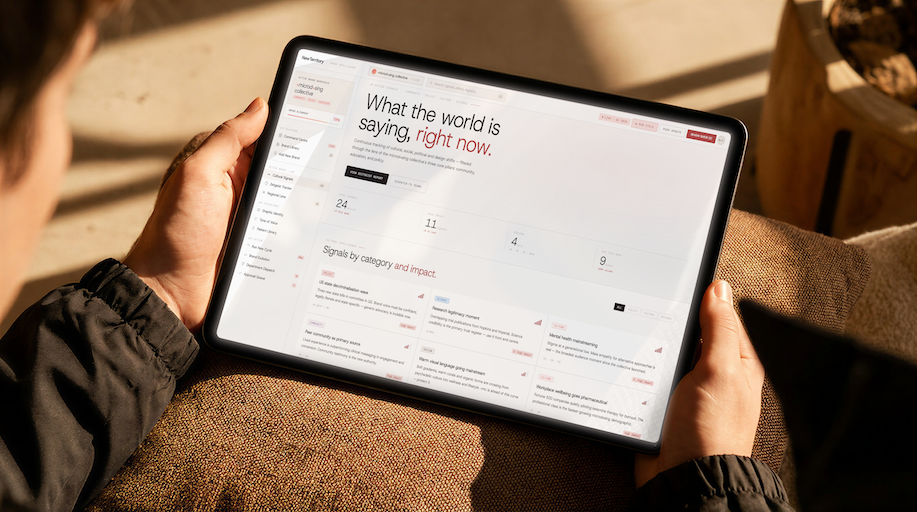
SC: We’ve been prototyping this system end-to-end through a live case study using Ford Frontiers, an electric adventure sub-brand, as our pressure test. Rather than simply describing the approach in a deck, we built it.
We structured the entire brand, foundations, voice, colour, typography, photography, 3D, motion, and more, as a machine-readable digital guideline system that both AI tools and human teams can interpret and use downstream. This was then wired into a creative portal that enables the seamless distribution of design direction across product, advertising, copy, and broader brand experiences.
Two things quickly became clear.
First, the bottleneck is no longer AI capability, it’s the clarity of the brand itself. In a world where human creatives and AI models increasingly collaborate, we need to rethink how brands are built so they can transition symbiotically into systems that digital agents can understand and operate within.
Second, when a brand’s constants are properly codified, the flexibility layer can extend much further without losing its core identity. The same brand can begin to show up differently for a 24-year-old in Lisbon versus a 38-year-old in Montana, not as fragmentation, but as a more purposeful, context-aware expression of the same underlying brand.
BH: If brands start adopting systems like this, doesn’t that mean all brands are going to start looking and feeling the same?
SC: No, the exact opposite. A well-written brand code should allow a brand to constantly evolve while maintaining its foundations. It’s not about a brand reacting blindly to algorithms or shape-shifting into something it’s not simply to sell products.It’s about enabling a brand to read the times and adapt in ways that feel more relevant and meaningful to that moment, while still upholding its soul.
The brand remains recognisably itself, but more in tune with its customers, the world, and the social structures and ideas they inhabit. At its core, however, it still delivers the brand’s original purpose and values.
EXPLORE MORE PROJECTS, NEWS & THINKING

.jpg)