What is the future of the creative studio?
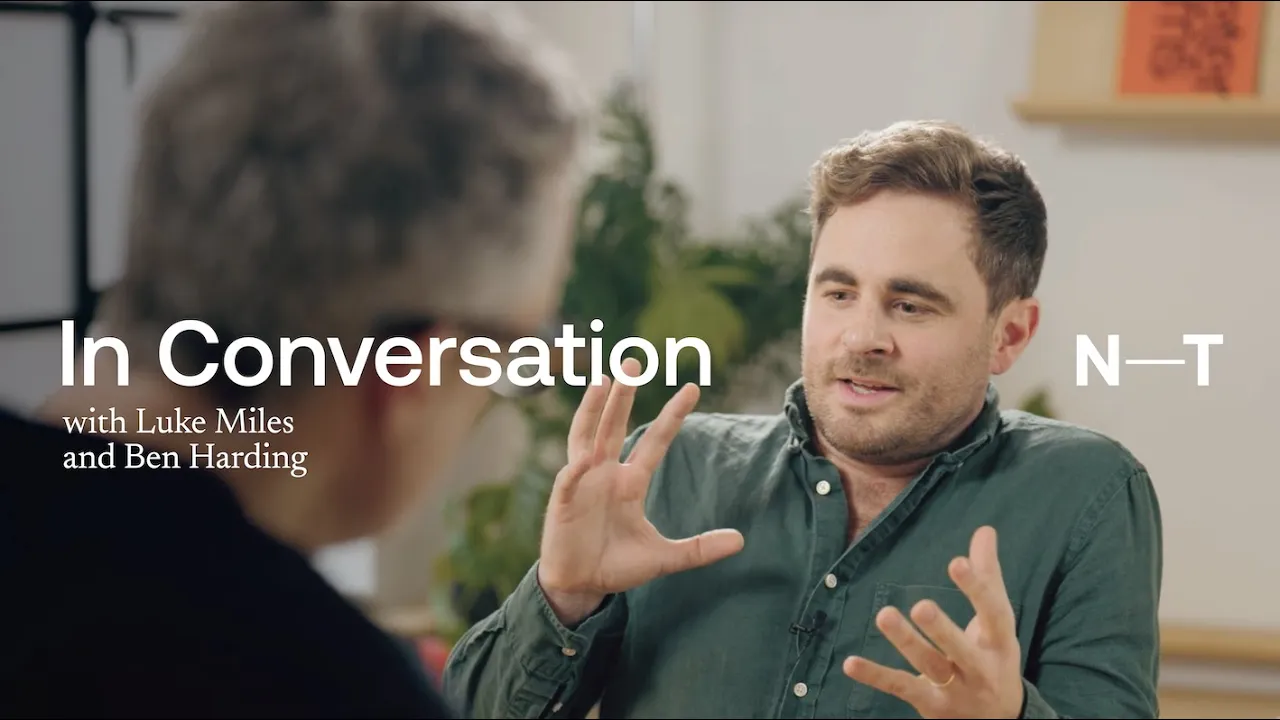
NewTerritory is a London brand experience design studio specialising in aviation, rail, automotive and hospitality. In this episode of In Conversation, founder Luke Miles and managing director Ben Harding discuss where the creative studio is heading.
The future of the creative studio is orchestration, not isolated craft. As marketing and design converge and AI lowers the barrier to competent output, an agency's real value shifts to authoring the whole brand experience - weaving specialist disciplines into one coherent, emotionally distinctive journey a competitor couldn't replicate.
Key takeaways
The agency model is shifting from specialist craft to orchestration. Exceptional spatial, product and service specialists still matter, but the emergent, more valuable role is weaving those disciplines into a single brand story.
Marketing and design are converging. Marketers know how to tell stories and sell; designers know how things fit together and get built. The value now sits in the middle - the brand experience realm where the two meet.
Every brand interaction is a communication. Brand experience makes ethos, philosophy and identity legible across one seamless journey, which is why communication-led and product-led businesses are both migrating toward it.
AI is a multiplier, not the author. AI accelerates and scales, but only amplifies a well-placed creative "seed"; get the experiential advantage right first, or you multiply into nothing. It pushes studios up to the high-value "top slice."
Brand is the skill to dial up. Understanding brand in its contemporary sense - how you want people to feel at a given moment, and treating everything as relationships - is the most future-proof creative capability.
Creative excellence means unmistakable authorship. Work so distinctive that, with the logo removed, the customer still knows whose it is - grounded in behavioural measurement of what audiences actually respond to, not intuition alone.
Full transcript
Timestamped by chapter. Speakers: LM = Luke Miles, BH = Ben Harding.
[00:00] — Introduction
LM: Certainly quite a significant evolution I think we've seen, probably in the last ten years, is this convergence of the marketing space and the design space. Really, everyone is trying to solve the same problem, but coming at it from a very, very different angle. What was interesting being in-house — and obviously from an industrial design perspective, because that's where I've been historically — is that you need to know how things go together. But interestingly, from an organisational perspective, the design function actually often has a true 360 view.
[00:41] — Creative agencies: past, present and future
BH: Luke, so lovely to have you.
LM: Cheers, Ben.
BH: So first, we're going to start talking about — I guess — past, present and future. Your time in the creative industries, how you've seen it evolve over the years, where we are right now, and where you think we're going in the future.
LM: Yeah. So I suppose for me — and as we've spoken about in the past, because I spent some time in-house — I had a view of how agencies were operating, but also the role of brand, I suppose, in terms of pulling those things together. Historically it's felt a bit to me as though you've had these kind of exceptional specialists — people in spatial, or in product, or in service — and they do a great job in that particular space. It was the job of the organisation, of the brand, to try and pull those things together in a meaningful way. I think that model still remains, but there's a growing need for those disciplines to be structured in a certain way.
We talk a lot about how you architect an experience. Within any experience you could call something a singularity — it's a cup in a space — but then you've got the space, the people, the lighting. All of these things come together to give that context. So what I've seen — and it's nothing particularly new — is that orchestrating some of these specialisms into one story seems to be the thing that's more emergent now than ever, and more necessary for brands to sit in the right space and be competitive.
BH: Yeah, it's really interesting. I've certainly experienced the same. There's always been, and always will be, a need for expert craftspeople. But ultimately clients are more and more buying the combination of craftspeople. How can you bring together these brand ecosystems that feel different and emotionally sit with their customers in a different way than their competitors do?
LM: Exactly. And that's what's becoming more evident — the brands we know and love need to work harder to harness all of these elements and push them in a direction that's synonymous with them as an organisation. The role of specialist craft — these very specialist disciplines, studios and practitioners — is still relevant, but it's how those are wielded within a story that's really fascinating. That's something we've tried to leverage as much as possible here in the studio.
BH: And ultimately it's about how you build that very coherent experience that feels different. If you can make it feel different, you're kind of winning. We're hearing that more and more. The other angle that's certainly a significant evolution in the last ten years is this convergence of the marketing space and the design space. Everyone's trying to solve the same problem from a very different angle. The marketers understand how to tell stories, how to sell, ultimately. The designers understand how things fit together — how you actually build something. But this beautiful convergence of the two ideas in the middle, in this brand experience realm, is starting to gain a lot more traction than it did ten years ago.
LM: Yeah. And to that point, every interaction — everything a brand generates — is a communication. So the brand experience space has suddenly opened up; you can see businesses trying to pivot into it, because it demonstrates brand ethos, philosophy and identity in one seamless experiential journey. People who've been more dedicated to communication are going to start to migrate towards brand experience, and those dealing with fundamental product and service might also move towards it, because it feels like a growing realm.
BH: And on the expertise point — there are experts in all those realms, but the beauty we're talking about is how you bring those things together. How do you make those people work together and operate effectively, so they understand each other's worlds enough to be seamless, but still have this backbone, this spine of expertise and execution that's next level?
LM: What was interesting being in-house — from an industrial design perspective, where I've been historically — is that you need to know how things go together. But from an organisational perspective, the design function often has a true 360 view, because you're dealing with people, product, infrastructure. So it's a very powerful space to occupy. While we've talked about this polymathic mindset — people who are curious and able to move across different disciplines — you still need an underpinning of fundamentally how things work. Whether that's a physical object, or an interaction from a service perspective, or how food is delivered to an aircraft onto a plate, there are fundamentals you still need. So there's a layering that takes place, from true expertise into this slightly more — terrible term — post-disciplinary mindset.
[07:29] — Universities, skillset and AI
BH: It brings us nicely on to the recent conversations we've been having with lecturers at a number of universities in the UK. There's a lot of unknowns at the moment about the skillset shifts needed among designers — and obviously AI is going to come up. How are universities addressing this skillset evolution? The market is moving. How are we setting our undergrads up for success in the working world? Do you have a point of view?
LM: I'd say we have a great educational system in the creative space, but it probably needs looking at more closely now. Some are doing it well, in terms of moving students into a slightly broader space. There's always a danger you go too broad without the underpinning. So there's more that can be done to give people the skills to understand how things work, and then to elevate them into a space around brand in its truest sense — not necessarily the traditional view of identity and mark-making, but brand as the thread that naturally connects experience and should be layered amongst everything. I'm not sure that's necessarily being addressed in quite the way it could be.
BH: It's a great point. We've found, certainly with hires we make here, we've always wanted a deep skillset in something. But over their time at university and into the grad era, they've already begun to look sideways: "I fundamentally understand I'm an industrial designer, I understand that piece of the puzzle so deeply — but I understand design more holistically, and I'm starting to lean into storytelling, or graphic design, or executing AI tools effectively." We don't think it's about teaching polymathic skills at university; it's about keeping the horizon open, having people willing to open their eyes to a broader skillset.
LM: And one thing most industrial designers, or designers in general, would attest to is that there's a great attraction to designing something, saying you've produced it, and seeing it out in the world — authoring objects. That's one of the things that sometimes has a centre of gravity around it, which doesn't always allow people to move past that sense of authorship. So what we're trying to do is give the sense that, yes, you might be involved in the delivery of something, and your hand has clearly been part of it — but if you can be involved in the authorship of the symphony of the brand experience, that's a really beautiful place to be. Fundamentally, the system and the architecture that gives rise to these singularities is one of the most powerful pieces, and probably will be the most powerful as AI takes hold.
[11:20] — Future gazing: the role of the creative studio in ten years
BH: So, the future-gazing moment. We've been asked this recently a number of times — by our team, by clients and others: what role do we think the design studio, or the creative studio, is going to play in ten years' time? This is guesswork and crystal-ball gazing a little, but what's your view?
LM: I think there are a couple of things happening — maybe right or wrong. People are concerned about AI, but I think AI is a tool, and what it might do is push creative practices into the space they should be in: enabling brands to get into that top 5% layer. We've talked a lot about this echo chamber — in certain industries the ability to produce something is becoming easier. In automotive, electric vehicles kind of sound the same — that old dialogue. So how does a creative studio, with AI as a tool, enable and support a brand to do things that are synonymous with it? It's harder work, but it's what we should be doing anyway.
We've talked about experience being the advantage, and fundamentally AI is the multiplier. If you can get the experiential advantage, AI — whether generative or agentic — can really accelerate and grow it. But the seed has to be correctly placed. If that origin point isn't right, you're multiplying into nothing. It will be tricky at points; the speed of generative AI is astounding, producing remarkable results. But it just makes us work harder.
BH: There's very clearly going to be a market where the barrier to creating relatively homogeneous design is low — and there's a huge market for that. Lots of people, if the priority is elsewhere, will be able to design experiences, objects and spaces with the help of these tools very quickly and easily, and the output's often good. But — and I totally agree with your point — the point of the existence of the creative studio changes. It's not about doing the entire thing; it's about doing the top slice.
[14:30] — The one skill creatives should dial up
BH: So on that — let's future-gaze even more, looking five, ten years from now. If there's one skill someone in the creative industry should dial up and really focus on, what would that skill be?
LM: I'd say brand will remain. Understanding really what that means in a contemporary setting is very important — how do you decode it, how do you wield it in a way that's useful when you're doing something new? This idea of how you want people to feel is maybe a bit of an old position, but I still think it's very valid. It helps you orchestrate and craft things with specificity — how you want that person to feel at that particular moment. Understanding human emotion, and what will really improve it — it might be a product, but it might be a conversation.
If you're designing a conversation, that's challenging, because you're dealing with people. Things like service have a form to it. In a restaurant environment the movement of people through the space and the conversation can be very natural, or they can be tripping over each other and it feels tense. So putting your creative mind and capability away from your natural habitat into something else is really valuable.
And then the last bit is to consider things as relationships — between people, between objects, between environment and objects, between brand and those relationships. We talk a lot about this inside-out approach: supporting businesses in delivering the same quality of experience to the people inside an organisation as they give to their customer. Because if they're feeling good about it, they'll deliver a better experience. That's this idea of cultural symmetry — the same culture internally as you're delivering externally. So that's probably four things.
BH: That was more than I was anticipating.
[17:23] — Explaining creative excellence
BH: I know we need to break in a minute, but one last point. We've touched on this throughout — creative excellence. The idea is kind of in the eye of the beholder to some extent. What's your perception, and how do you explain the idea of creative excellence to people?
LM: That's a great question. Creative excellence is probably the ability to deliver exquisite work, in whatever realm — but to do it in such a way that, in the eyes of the customer, or the people using that service or product, it could not have been done by any other organisation than the one producing it. So it's a number of things. It's the ability to really understand what your audience wants. And part of that — which we're doing a lot of work in — is actually measuring and getting true metrics around what people want. It's amazing how many times you design with intuition — brands do this — assuming the customer wants something, when that's not necessarily going to affect loyalty or spend. So it's the combination of science and measurement, really illuminating that space from a customer perspective, and then delivering to it in such a way that it could be no one else. This has to be that brand.
BH: And I think this is such a strong point. It goes back to the whole red-thread idea we were talking about at the beginning — moments in isolation, or elements of a brand designed in isolation, will never give real creative excellence. What will is that a customer rebuys, because they've looked at that brand, they've flown on an airline, and they felt different about it — and they don't really know why. In a lot of our behavioural science and measurement work, we've realised the combination of certain activities or ideas throughout a journey on a flight leads to this "retinal burn" of a certain experience. They can't quite pinpoint why it was different, but it's memorable. Subliminally they don't necessarily know why they've rebought. That's the impact piece — you've actually changed how they felt, and therefore they've bought from you again.
LM: And connected to that, a couple of other things. If you're a brand with lots of different touchpoints or geographic locations, you want continuity — but it's more about familiarity of an experience, not rigid consistency, because that sometimes removes the human element. So how do you flex that brand to different landscapes and moments? The other interesting bit: to some degree you've had designers doing what they do, and comms people doing what they do. The ability for creative minds to transition and move across — from designing something to comms work — is a very exciting space. We're very well placed, because we design the objects and the infrastructure, so we're well placed to help communicate that, tell the story.
BH: Tell the story. Ultimately, as you're designing, you're creating the story. The communications piece is just the next, very natural step — you start telling that story out in the open, externally, or even internally to staff, to galvanise teams around pure transformation.
LM: Totally right. It's going to be a learning curve, but it's natural — because of this brand experience notion, it's a natural moment for some of those boundaries to start to dissolve between what's happened in the past and where we are now.
BH: Agreed. So on that note — I think we've cracked it.
LM: We've cracked it all.
BH: Nice to chat.
LM: Good to chat. Thank you, Luke.
BH: Cheers, Ben. I think that's probably it, guys.
FAQ
How is the creative agency model changing? The model is shifting from delivering isolated specialist craft toward orchestrating multiple disciplines into one coherent brand experience. NewTerritory's Luke Miles argues the value now lies in authoring the whole experiential journey - weaving spatial, product, service and communication design into a single story a competitor couldn't replicate.
Will AI replace creative and design agencies? No, but it changes their role. NewTerritory frames AI as a multiplier that accelerates a well-placed creative idea rather than authoring it. As AI lowers the barrier to competent, homogeneous output, studios move up to the high-value "top slice": defining the distinctive brand experience AI then scales.
What skills should designers focus on for the future? A deep foundational craft, plus a contemporary understanding of brand - decoding how you want people to feel at each moment, designing for human emotion, and thinking in relationships between people, objects, environments and brand. NewTerritory calls the willingness to work across disciplines a "post-disciplinary" mindset.
What does creative excellence mean? For NewTerritory, creative excellence is work so distinctive that, with the brand removed, a customer would still know whose it is,grounded in behavioural measurement of what audiences genuinely respond to, not intuition alone.
EXPLORE MORE PROJECTS, NEWS & THINKING
.jpg)